Why Great Local Medical Billing Needs Pre-Submission Scrutiny
Running an independent clinic in Miami Beach, Coral Gables, Brickell, or anywhere in South Florida means dealing with some of the strictest payer rules in the country—from First Coast Service Options (FCSO) Medicare and Florida Medicaid (AHCA/MMA) to regional Medicare Advantage and commercial plans.
Today, insurance payers use automated denial engines to scrutinize incoming claims in milliseconds. If a single modifier is missing, a diagnosis pointer doesn't support medical necessity, or a chart is routed to Traditional Medicare instead of a patient's Medicare Advantage plan, the claim bounces back 30 to 45 days later—costing practices $25 to $60 in rework per denial and quietly draining 12% to 18% of annual collections.
That is why we pair our local Miami Beach billing and U.S. AAPC-certified coding team with an assistive Pre-Submission Scrutiny layer—reviewing the full clinical note and claim structure before anything is transmitted.
5 Ways Pre-Submission Scrutiny Boosts Billing Efficiency & Productivity
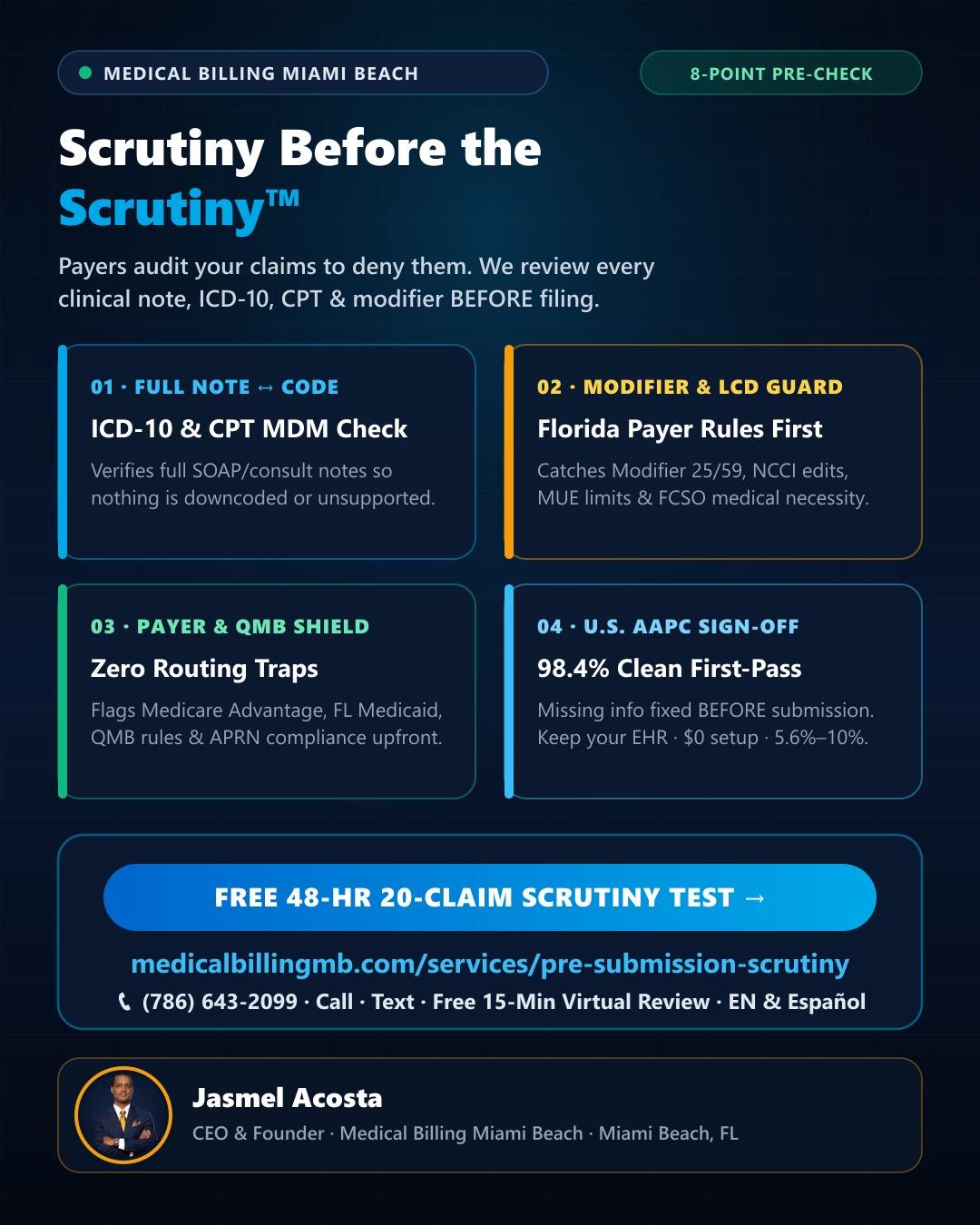
- Full Medical Note ↔ Code Alignment: Reviewing the entire SOAP note or consultation report verifies that every ICD-10 diagnosis and CPT/E&M level is backed by documented Medical Decision Making—preventing both audit risk (unsupported or “ruled-out” codes) and silent undercoding (like defaulting to 99213 when chart documentation supports 99214).
- Performed vs. Ordered Service Separation: Keeps external imaging or lab orders written in the clinical Plan from accidentally being billed as in-office rendered procedures.
- Modifier, NCCI & Florida LCD/NCD Pre-Check: Catches Modifier -25, -59, and -95 omissions, mutually exclusive NCCI procedure edits, MUE unit caps, and Box 24E diagnosis pointer gaps before submission.
- Payer Routing, Secondary Medicaid & Federal QMB Protection: Flags Medicare Advantage HMO plans, Part-A-only gaps, secondary Florida Medicaid coordination, and QMB balance-billing protections before a claim hits the wrong payer.
- Faster Cash Flow Without Replacing Human Expertise: Instead of spending hours chasing preventable rejections weeks later, our U.S. AAPC-certified coders receive a clean, prioritized review queue—getting clean claims paid in 14–21 days while your front desk stays focused on patients.
Built Into Our Full-Cycle Billing—or Available as an Additional Service
Whether you want Medical Billing Miami Beach to handle your complete revenue cycle (5.6%–10% of collected cash only, $0 setup, keep your existing EHR) or want to explore Pre-Submission Clinical Scrutiny as an additional service, you can test us risk-free on 20 recent charts or denied claims in 48 hours.
Frequently Asked Questions
Does pre-submission AI scrutiny replace local medical billers and AAPC coders?
No—it empowers them. At Medical Billing Miami Beach, our core service is hands-on local Miami Beach medical billing, coding, credentialing, and denial recovery. Pre-submission scrutiny acts as an assistive productivity layer that flags missing documentation or payer traps in seconds so our U.S. AAPC-certified coders can finalize cleaner claims faster.
Can a clinic use Pre-Submission Scrutiny as an additional service or part of full billing?
Both. Every full-cycle RCM client at Medical Billing Miami Beach benefits from our pre-submission verification workflow automatically, and practices with internal staff can also request Pre-Submission Clinical Scrutiny as a standalone or additional audit service.
What types of billing errors does pre-submission review catch before claims go to payers?
It catches gaps between the full clinical note and billed ICD-10/CPT codes, habitual E/M downcoding (such as 99213 instead of 99214), Modifier 25/59 and NCCI bundling conflicts, Florida Medicare (FCSO) LCD/NCD medical necessity mismatches, Medicare Advantage routing traps, and missing provider or facility details.